
What would it be like if Jesus had made himself flesh and blood and walked the earth in our time? There would have been a lot of photographic evidence, a lot of selfies.
The disciples may have posted about their journey with Jesus. Peter would have been all over the socials.
He may have captured the significant moments.
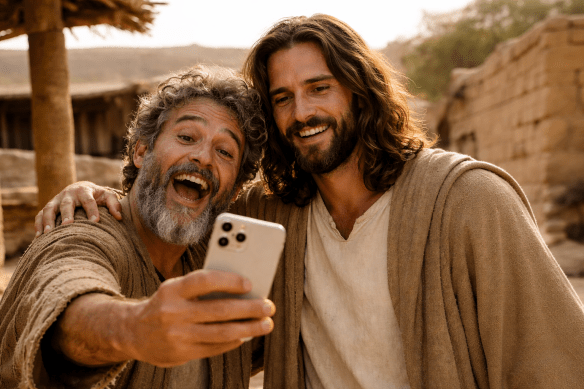
Selfie with Jesus and a boatload of fish. ‘I’m following Jesus now.’ #followingJesus
I’m sure he would have posted a selfie with Jesus saying, “Jesus is the Son of God, the Messiah.” He took that one down when Jesus said, “Get behind me Satan.”
There would definitely have been one of Jesus at the Transfiguration. ‘Wow look, Jesus glorified he is like… glowing. Amazing!’
The Last Supper would have featured wine, Peter, and the rest of the lads gathered around Jesus.
The last one, Peter holding up a soldier’s ear before he’s told off by Jesus. He takes that one down.
But that night he denies Jesus and then there’s social media silence.
He’s still there, quiet, no longer posting. You are checking to see what anyone else has put up, to see if they said anything about you but you’ve stopped posting. Everything’s gone quiet on the socials.
Reading the story afresh
Whenever I read the Bible I’m looking for fresh revelation. Not in the academic sense, of finding new things, but in the sense of hearing the Holy Spirit. Having him show me new insights and understandings for my walk with Jesus.
Recently I noticed two words in the resurrection account in Mark’s Gospel.
An angel is talking to the women, including Mary Magdalene:
Mark 16,6-7. ‘Don’t be alarmed,’ he said. ‘You are looking for Jesus the Nazarene, who was crucified. He has risen! He is not here. See the place where they laid him. But go, tell his disciples and Peter, “He is going ahead of you into Galilee. There you will see him, just as he told you.”‘
The two words that struck me were “and Peter”.
Why is Peter named in particular beyond the disciples, is it an afterthought?
Peter, who has denied Jesus, who has gone on social media silence, who isn’t looking so cocky. He hasn’t got all the answers. Instead he’s shrouded in shame.
He’s named because the angels know that he’s currently walking in shame because of what he’s done.
Gone Fishing
The resurrection accounts in the Gospels are all different. Each one of them has a different emphasis.
It’s one of many things that makes the Gospels more believable. If all the accounts aligned perfectly, you would know that they were colluding. But that’s not the case, each one writes from their own perspective and for a particular purpose. Because there are lots of different camera angles, we can be sure that they’re not making it up.
In Matthew’s Gospel, the women encounter the resurrected Jesus. There is a report from the guards, then the Great Commission.
In Luke the women attend to the body of Jesus and then the angels appear. They report back to the disciples and Peter gets up and runs to the tomb. Two disciples then encountered Jesus on the road to Emmaus. As they report back there’s one line about Jesus appearing to Simon (Peter). Then all the disciples see Jesus and he ascends to heaven.
In John’s Gospel we have a lot more detail. There are two angels who are seated either side of where Jesus’ body lay. A hidden picture of the Ark of the Covenant. Hinted at in John 1:29 when John says, “Look the Lamb of God who takes away the sin of the world.” The mercy seat is empty. Rather than the cherubim kneeling in worship, they are seated at his head and his feet, saying, “He’s not here.” The debt is paid, the sin taken away, and God is present on the earth.
Mary Magdalene turns and sees the risen Jesus. Returning to the disciples, with the news, she says, “I have seen the Lord.” John 20:18.
Jesus then appears to all the disciples, except Thomas, and they report to Thomas, “We have seen the Lord” John 20:25. Then Thomas sees Jesus and makes his declaration, “My Lord and my God.” John 20:28.
But Peter is still quiet on social media, still walking in shame so he goes back to what he knows: a fishing trip. But without Jesus by his side, it’s no longer fulfilling or successful. They catch nothing. So Jesus appears on the shore and tells them to throw their nets out on the other side. Right back to the original calling. He’s teaching them how to fish. Nets are too full to pull in, 153 fish. It’s a strange detail then to include. I imagine them after breakfast, sitting and counting them.
While they’re still in the boat Peter realises it is the Lord. He is still shrouded in shame but he knows where he wants to be. He doesn’t know how to get there so he splashes through the water into the presence of Jesus.
Jesus has arranged them breakfast. There’s bread, there’s burning coals, and there’s even fish. Fish that Jesus has provided, not hauled in from their boats. Breakfast finished, the restoration begins.
Back to Mark’s gospel. Jesus is risen and the angels tell the women to go and announce the news to the disciples and Peter. Jesus said that he would deny him. Peter was sure he wouldn’t. He would stand with Jesus even till death, he would cut off a soldier’s ear for Jesus. But then in the moment that mattered. The one who so often led with strong words let himself and his Saviour down by denying that he even knew him. Not once but three times.
So often the things that are foremost in our character, Jesus needs to refine before they can be for his glory. For Peter, it was that flamboyant leading from the front. Peter Has not yet surrendered his character to the lordship of Jesus. He goes away that night and weeps bitterly.
We’ll come back to Peter shortly but first of all we need to talk about sin.
Sin ledger
As a follower of Jesus I never want to take for granted the enormity of what Jesus has done.
Sin is any breach of the commands of God. When I fall short of His standards, the Bible calls this sin.
Sin has consequences. It separates us from God, from each other and the world. The Bible says that the wages of sin is death. There are so many ways of understanding the nature of sin and its consequences. One of these images equates sin with having racked up debt and it is holding us to ransom.
Sin is like the lines on a ledger in a record of accounts.
My sync adds transactions to the account and the ledger soon stacks up. I’m in debt to almighty God because of what I’ve done and I’m unable to pay this debt by myself.
Over time this ledger becomes an enormous book. God keeps an account but I think the devil also keeps an account. The ledger says that there is a debt that is outstanding in my name.
Your ledger is full of the records of what you’ve done. This is not an account that you cannot settle by yourself. The devil holds it against you and uses it to condemn you and lead you into shame and despair. But God holds it for a different reason.
God loves us so much that Jesus comes into the world to deal with the wages of sin, to deal with death.
Jesus, is fully God and fully human, is the first person to have a complete clean record. His ledger shows that there is no debt outstanding. It’s clean and empty. There is no price for him to pay.
So when Jesus dies on the cross, the Father lays on him the ledgers of us all. In that moment as Jesus takes the consequence of our sin, he takes on himself the wages of sin, our death. In that moment cuts him off from God the Father on our behalf. He undergoes spiritual death before physical death.
Jesus bears the sin of the whole world. Every one of our ledgers piled upon him and the accounts send him charging into the depths of hell.
The devil thinks he’s won. That he has killed God’s Son. That he has defiled and destroyed with death God himself.
Jesus takes the account that held us ransom and confronts the devil.
An account that we could not settle held us in shame and condemnation. Death was the required payment.
Jesus came in our place and he pays the price. He dies physically and spiritually. Jesus takes our ledger to the depths of hell and pays the whole account to set us free.
Jesus was the sinless Saviour who paid the price for us all. But death could not hold him. There was no account, no ledger against his own name. He paid the price for us, he burst out of hell, rose from the grave. The resurrected Jesus having paid the price for our sin and defeated death.
It’s done. Jesus paid the ledger.
So when the devil looks at your sin record, it’s empty.
When God the Father looks at your record of sin, it’s empty.
We are no longer dead in our transgressions. We are no longer slaves to sin. We are no longer under condemnation. Free and alive in Him, debts paid. He reconciled the ledger once and for all.
Living from security
Thirty-two years ago, Meghan and I made a choice to be married. We stood in front of our family and friends and before God and made vows to each other.
Our legal status changed. The vows that we made were for better or for worse. They were a declaration of our ongoing love and commitment to one another.
We are doing some daily readings together as a couple. They have reminded us of that choice that we made to be married and that it is an ongoing choice each day. Being settled in that choice is one of the reasons why our relationship thrives.
Things would be very different if I did not live in this reality. If I woke up each morning and wrestled with the legality of our marriage. Considered the choice I was going to make that day. Doubted whether I loved my wife and whether she loved me. The relationship would be horrible.
Can you imagine the pain of starting the date like that? Sitting at the table for dinner, you agonise over whether you love her and she loves you. ‘Are we okay? Is this alright? Are we even married?’
Sometimes we approach Jesus like this.
We come crawling into His presence. Asking:
Will you accept me today?
Do you love me?
Have you forgiven me?
He wonders what we are doing? His response to our grovelling approach to his throne room?
“I’ve clothed you in righteousness.”
“I’ve paid for your sin.”
“It is done.”
“It is finished.”
“Ledger paid.”
Living from the truth of my position before Jesus grows my relationship with him. Approaching his throne of grace with grovelling tears it apart.
Shame leads to sin
There is a pattern of behaviour with addicts that is true for us all. When we’ve stumbled back into sin, the shame that so covers us leads us in a cycle of repeated sin.
When I’m working with addicts we often talk about sin as a sweet shop. A place that you visited because you thought that things tasted nice. But the sweet shop is actually a place of destruction for you.
Having made the choice not to visit that shop anymore, the idea is to put it as far away from you as possible. You want to avoid walking down that road, visiting that end of town.
When we’re caught up in shame we can find ourselves back at the counter of the sweet shop. How did we get here? How did we get this close to living in that world again.
The biggest lie is that it was one moment of temptation that led us back to that parlour of the delights. But the reality is the decision was not made in the shop or even on the road but a thousand steps before. Each step covered in a little bit more shame and a little bit more condemnation. We edge back in the direction that we long to escape from.
You made the decision when you chose what you say about yourself over what Jesus says.
You made the decision when you chose to believe the enemy rather than the Father. In Jesus, there is no condemnation.
This is a struggle not for addicts alone but for every single one of us. We try to walk in the fullness of who Jesus has made us to be, yet so often we stumble back into our old ways. We’ve been eyeing up the sweet shop for years.
Account Paid
My Father-in-law Tony has an annoying habit whenever we go out for dinner. It’s a Fatherly thing. He always sneaks off to go and pay the bill. He’s insistent about it. He will not entertain any conversation that anyone else could pay the bill for the meal.
As a married man there’s often a kick under the table when we’re having dinner. This is the instruction from my wife that says I’m to get up and sneak out and try and pay the bill before Tony does.
Over time I’ve come to pre-empt this and sometimes I will now sneak off to the loo at dessert and go and pay the bill. Sometimes I even get there before Tony does.
This has become a challenge between us to see who can sneak out to pay the bill first. What a joy it is when I see Tony going to the counter to try and pay a bill that’s already settled. What gratitude I have when he gets there first and pays the bill. I always make a point of thanking him.
It’s done. It’s paid. I’m grateful.
Forgiveness is like that, Jesus has paid the bill. Yet we’re still insistent. We go to the till or find the waiter or the waitress saying, “Can I have the bill please?”
Jesus says, “You can’t pay it. I’ve paid the bill. It’s done.”
Back to the beach
The call from Jesus to his disciples at the start of his ministry is “Follow me.” They spend the next three years figuring out what that looks like.
The key thing about being a disciple of Jesus is following Jesus.
Peter is so adamant that he will follow Jesus even to death. He insists that he would lay down his life for Jesus.
Jesus knows what’s going to happen: that Peter will deny him three times.
Jesus continues to talk about his death John 14, “Do not let your hearts be troubled.” This was not what Peter had signed up for. This is not defeating the Romans.
Later in the garden, Peter, determined to prove Jesus wrong, draws his sword and cuts off a soldier’s ear. He’s willing to defend Jesus, to go with him to the death.
Confusion overtakes Peter and the disciples. Jesus is talking about things that they can’t yet understand. Rooms in heaven, being the way, the truth, and the life. Jesus going away, dying.
But Peter’s missed the point. This is not the plan. He’s misread it again and then the denials come.
At what point did his confusion turn to understanding?
Peter goes in search of Jesus at the tomb.
He doesn’t see him, but at some point before the other disciples see him. Then Jesus appears to Peter.
He stopped posting but he’s still searching the socials for peace.
He’s still weighed down by the shame of his denials.
Jesus keeps on appearing but things for Peter have not yet been reconciled. He’s not at peace.
Then at the end of John’s gospel, after breakfast, Jesus addresses the weight that Peter carries.
There are the repeated phrases that re-commission Peter for leadership:
- Feed my lambs.
- Take care of my sheep.
- Feed my sheep.
Much has been written on the nuance of Jesus’ phrasing of this. I want to focus on what happens afterwards. Jesus says the two words that are most important for Peter to hear, for us to hear.
You might want to take a moment to take stock of them, to write them down, and to never move beyond them. It’s the most important thing for any of us Christians to hear. If you’re a leader, then you need to hear it even more. Notice these words come after Peter has been recommissioned for leadership not before. The words of Jesus in John 21:19 are really simple:
“Follow Me”
That’s it. Follow Jesus.
But what does following look like?
What’s your frame?
I understood when I was growing up that following Jesus always required a decision.
I read the resurrection accounts. I see Jesus, completely pure and holy, has died on a cross to pay for the sin of the whole world and raised from the dead. Therefore, as he appears before his disciples and what he should say is something like. ‘I have paid the price and now you need to repent of your sin and believe, then will be saved.’ This is the correct order of things, isn’t it?
Jesus pays the ransom.
I repent and believe.
Jesus saves me.
This is how you become a Christian.
But this is not what happens with the disciples.
I had to search back through John’s Gospel to find out why.
In John chapter 13, Jesus is washing the disciples’ feet and Peter says to the Lord, “You will never wash my feet?”
Again Peter’s mouth gives him away that he does not yet understand what Jesus is doing. As Jesus explains, his enthusiasm again takes over. Then not just my feet but my hands and my head as well says Peter.
Then the declaration of Jesus.
“You are clean.”
The early followers of Jesus were already covered by his death because they had chosen to follow him. They were all ready clean.
Dear followers of Jesus,
You are clean.
Your sin has already been paid for.
The slate is completely clean.
It is done.
It is finished.
The issue is, do you want to agree with Jesus, or do you want to keep on doing it your own way?
Do you want to keep on fighting him and saying, oh, Lord, I can do this. I can pay the bill. I can pay for myself. I can sort the ledger out.
We put so much effort into making ourselves into a presentable offering for Almighty God. Look how fabulous I am! Look what an amazing job I’ve done. Presenting myself as a holy living sacrifice, clean and pure because of all the things that I’ve done.
All the time that we try and do it ourselves, we hide ourselves away from the reality of his presence with us.
It is done. You are clean.
Whenever we don’t live in the reality of that, the shame leads us back to the old sweetie shops.
The transaction of forgiveness does not happen at the point that you say, Jesus, forgive me.
He has already settled the account.
He’s already paid the price.
He’s already paid the whole of the ransom.
It is done.
The issue is, do you agree with Jesus or not?
That’s what confessing your sin is. It’s not confessing your sin so that he forgives you. It’s confessing your sins so that you come into agreement with the fact that he has forgiven you.
Either agree with him that you are clothed in righteousness. Have a right to enter his throne of grace or you can choose to do things your own way. Trying to re-fill the ledger book with the echos of your sin.
I don’t have anything more complicated to say. It’s simply this.
Dear church, dear Christians, follow him.
That’s it. All that remains is: how will you follow him?
The only way to do it is on his terms not yours.
Are you centre stage?
I spend about half my time taking funerals and coaching people what to say about the person who has died. I notice two different pitfalls between the generations in how they speak of their loved one.
Older generations they can sometimes speak more about the circumstances of someone’s life. Missing character and heart in favour of describing the events and the roles.
It’s different with the younger generation, those who have been had a diet of social media. In trying to honour the person that they love, their language can be self-centric.
It’s interesting then to apply this to how we follow Jesus. Both of these approaches lead us away from intimacy with him. The first keeps things factual but distant. The second expects Jesus to meet us on our terms.
Following Jesus is more than intellectual assent to information. We need to get off the stage of our own lives and re-orientate our thinking and living around Him. To follow Jesus is to do so on his terms not ours.
So let’s stop pretending. Stop trying to rebuild a life of sin and shame when he’s done it.
We’ll find it so much easier to avoid the sweet shop if we do life on his terms, rather than our terms.
Following Jesus means to agree with what he says about us.
He’s paid the bill. He’s cleared the ledger.
It is done.
You are clean.
Let us then approach God’s throne of grace with confidence (Hebrews 4:16)
 Mark Searle